Digital Camouflage
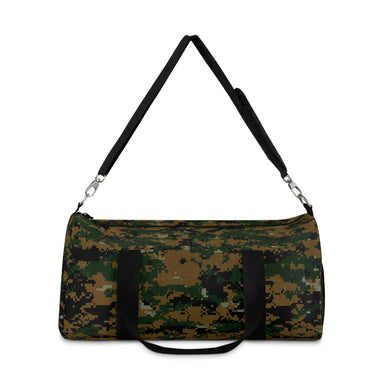
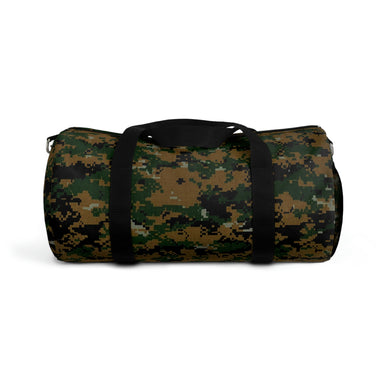
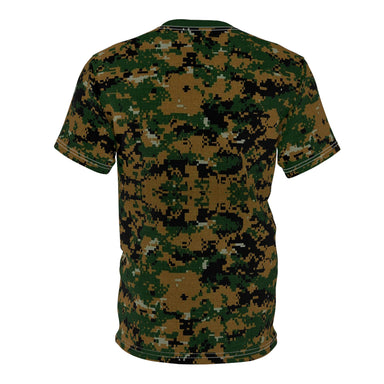
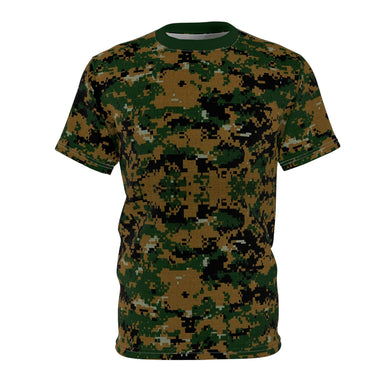
Digital Camouflage (also called pixel camouflage or pixelated camouflage) is a family of camouflage patterns made from small square or rectangular pixels instead of traditional blotches, brushstrokes, or geometric shapes. Developed using computer-assisted design, digital camouflage creates a layered visual effect that helps conceal the wearer across multiple distances.
Key Features
- Pixelated design: Thousands of tiny square pixels form larger camouflage shapes rather than appearing as random blocks.
- Multi-scale effect: Small pixels blend together at close range while larger clusters disrupt the human outline at medium and long distances.
- Computer-designed: Unlike earlier hand-drawn patterns, digital camouflage is developed using mathematical and visual analysis to optimize concealment.
- Environment-specific colors: Available in woodland, desert, urban, jungle, and transitional variants.
History
- The concept was explored in the late 20th century, but the first widely adopted digital camouflage was Canadian CADPAT, introduced in the late 1990s.
- The U.S. Marine Corps followed with MARPAT, one of the most successful digital camouflage systems.
- Many countries later developed their own pixel-based patterns, leading to widespread adoption during the 2000s and beyond.
Notable Digital Patterns
- CADPAT (Canada) – The first operational digital camouflage, designed for woodland and later arid environments.
- MARPAT (United States Marine Corps) – Woodland and desert versions optimized for Marine operations.
- UCP (Universal Camouflage Pattern) – A gray-green digital pattern used by the U.S. Army from 2004 to 2019; it was intended as a universal pattern but proved less effective in many environments.
- Type 07 (China) – A family of digital camouflage patterns for different branches of the Chinese military.
- EMR (Russia) – A pixelated woodland pattern often nicknamed "Digital Flora."
- Numerous other nations have adopted their own digital camouflage designs.
Advantages
- Effective at multiple viewing distances due to its layered structure.
- Breaks up the wearer's outline while also blending with natural textures.
- Easily adapted to different environments by changing the color palette.
- Compatible with modern computer modeling and testing techniques.
Limitations
- No digital pattern is universally effective; color selection remains more important than pixel shape.
- Some early "universal" digital patterns performed poorly because they attempted to work in too many environments.
- Performance depends on terrain, lighting, movement, and viewing distance—not just the pattern itself.
How It Works
Digital camouflage uses micro-patterns (individual pixels) and macro-patterns (larger shapes formed by groups of pixels). At close range, the fine pixelation reduces obvious edges. At greater distances, the pixels visually merge into larger disruptive shapes that help conceal the human silhouette.
Legacy
Digital camouflage has become one of the defining camouflage styles of the 21st century. While newer camouflage systems often combine digital elements with organic shapes, the concept of using computer-designed, multi-scale patterns has had a lasting influence on military uniform development worldwide.
In summary, Digital camouflage is a computer-designed, pixel-based camouflage system that uses tiny square elements to create disruptive patterns effective across multiple distances. Its adaptability and scientific design have made it a standard choice for many modern armed forces.